

The most significant longevity discovery of the past two decades did not come from a laboratory studying genetics, nutrition or exercise. It came from a psychologist at Yale who asked a deceptively simple question: what happens to the body when the mind believes that ageing means decline? The answer, replicated across decades of research, is both sobering and extraordinarily liberating. The story we tell ourselves about getting older is not a reflection of how we age. It is a cause of it.
What the Research Says About Age Beliefs and Longevity
In 2002, Yale School of Public Health psychologist Becca Levy published findings from a study that had tracked a cohort of older adults for more than two decades, investigating something most of the medical establishment considered too soft to study seriously: the relationship between how people think about ageing and how they actually age. What she found changed the field.
People who held positive beliefs about their own ageing lived, on average, seven and a half years longer than those who held negative ones. Not months. Years. The finding held after controlling for age, gender, socioeconomic status, loneliness and functional health. It has since been replicated across multiple populations and cultures. Seven and a half years is more than the longevity benefit associated with not smoking. More than the benefit associated with regular exercise. More than almost any single clinical intervention medicine has to offer.
But Levy did not stop there. Her subsequent research found that people with positive age beliefs were 44% more likely to fully recover from severe disability than those with negative ones. They showed significantly lower rates of cardiovascular disease. They demonstrated better memory performance under pressure. And they were substantially less likely to develop the brain changes associated with Alzheimer’s disease.
The mechanism, she concluded, was not magical thinking. It was the measurable physiological impact of chronic psychological stress: specifically, the stress of believing that deterioration is inevitable, that your best years are behind you, and that the appropriate response to later life is retreat.
When that belief is replaced, genuinely replaced, not papered over, the body responds accordingly.
Where Negative Age Beliefs Come From
Here is the part that should make you pause.
The internal voice telling you to slow down, step back, dress appropriately and stop starting things is not originally yours. Levy’s research traces these beliefs back to early childhood, long before we had the critical faculties to question them. By the age of four, children are already absorbing cultural messages about what it means to be old. They watch how older people are spoken to, spoken about, and represented, or not represented, in the world around them. They form beliefs. Those beliefs go underground. And decades later, they resurface as the quiet, authoritative inner narrator who tells us what people our age can and cannot do.
The Counterclockwise Study: When the Body Believes the Environment
Harvard psychologist Ellen Langer demonstrated just how completely the body believes this narrator. In her now legendary 1979 Counterclockwise study, Langer took a group of men in their seventies and immersed them for one week in an environment designed to mirror life twenty years earlier: the music, the newspapers, the conversations, the physical surroundings. The men were not asked to pretend or perform. They were simply placed in a context that treated them as younger.
Within seven days, their hearing improved. Their vision improved. Their grip strength increased. Independent observers, shown photographs taken before and after, consistently judged the men to look younger at the end of the week than at the beginning. Their bodies had followed their revised context with a literalness that astonished researchers.
Langer’s conclusion was not that we can think ourselves young. It was that the body is far more responsive to psychological environment than medicine had previously believed, and that environments which expect vitality tend to produce it.
This is not a peripheral finding. It is one of the most important arguments for how we design the later years of life.
The Ageing Scripts We Inherited
Most of us are running an internal narrative written for a previous generation. A generation that retired at 60 into genuine physical decline, that had fewer tools, fewer options and a cultural script that offered very little between full productivity and graceful withdrawal.
That script is now demonstrably outdated. Not as a matter of positive thinking, but as a matter of biology, medicine and demography. We are living longer, staying healthier and remaining cognitively sharp well into our eighties and beyond in numbers that have no historical precedent. And yet the inherited narrative persists, surfacing in moments of hesitation, self-editing and quiet self-dismissal.
Recognise any of these?
I’m too old to start something new. I should be slowing down by now. That’s not really for someone my age. I don’t want to make a fool of myself. I’ve had my turn.
These are not observations. They are not facts. They are inherited scripts, absorbed before we had any way to evaluate them, running on a loop in the background of daily life. And according to Levy’s stereotype embodiment theory, they are quietly shaping our biology as they run.
Viktor Frankl, whose work on meaning and survival remains one of the most compelling bodies of thought in modern psychology, argued that the human capacity for self-narrative is not incidental to health. It is central to it. Those who maintain a coherent, purposeful story about their own lives, he found, demonstrate measurably greater resilience, recovery and longevity. The story is not decoration. It is infrastructure.
And if the story we are telling is one borrowed from a culture that has chronically underestimated later life, the first act of reinspirement is simply to notice that, and to begin writing something more accurate.
How to Rewrite the Script: Positive Ageing in Practice
This is not an instruction to think positively. Positive thinking without honest reckoning is just another form of self-deception, and the research does not support it. What Levy’s work supports, and what Langer’s experiments demonstrate, is something more rigorous: a conscious, evidence-based decision to audit the language you use about yourself and your age, and to replace inherited assumptions with ones that are actually true.
The Blue Zones offer a useful model here. In every community in the world where people routinely live past 100 in good health, there is a cultural framework, often embedded in language itself, that expects vitality in later life rather than decline. In Okinawa, the concept of ikigai, a reason for being, a reason to get up in the morning, has no retirement age. In Sardinia, the word pari carries an expectation that elders remain vocal, physically active and socially central. These are not individual mindset choices. They are cultural scripts. And they produce measurably different biological outcomes.
We cannot change our culture overnight. But we can change our own internal language: deliberately, repeatedly, and with the knowledge that doing so is one of the most evidence-backed longevity interventions available to us.
Here is what the rewrite looks like in practice:
| THE INHERITED SCRIPT | THE REWRITE |
|---|---|
| I’m too old to start something new | I have more patience, perspective and self-knowledge than I’ve ever had |
| I should be slowing down by now | I get to choose my pace, and today I choose momentum |
| That’s not really for someone my age | Says who, exactly? And when did I agree to that? |
| I don’t want to make a fool of myself | Trying something new is not foolishness. Stopping is. |
| I’ve had my turn | This is my turn. The one I actually chose. |
| I’m not sure I can still do that | I won’t know until I try, and trying is the point |
Designed for Positive Ageing
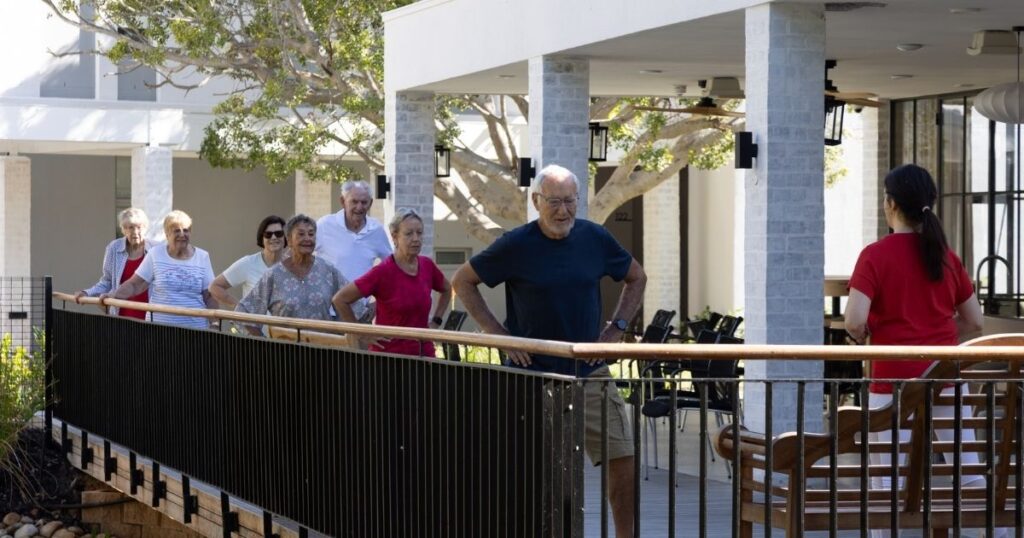
None of this happens in a vacuum. Langer’s research showed that environment is not a backdrop to belief. It is a primary shaper of it. The physical and social context we inhabit every day either reinforces the old script or invites a new one.
When daily life includes movement that is designed for longevity rather than performance, creative practice that asks something of you, a community that expects engagement rather than withdrawal, and a home that removes friction rather than adding it, the rewrite becomes not just possible but natural. The environment does some of the work. [IL 3: estate community page]
This is not accidental. It is the result of deliberate design choices about what later life can look like when it is taken seriously. When it is built around the evidence of what actually supports human flourishing in the third age, rather than around outdated assumptions about what people beyond sixty need or want or are capable of.
The most powerful longevity tool you own is the story you tell yourself about your own age. The research is unambiguous. The only question is whether the story you are currently telling is one you actually chose, or one you inherited without noticing.
It is not too late to rewrite it. In fact, according to the science, there has never been a better time.
FAQ: Positive Ageing
What is positive ageing? Positive ageing means holding accurate, non-defeatist beliefs about your own later life, and living in a way that reflects them. Research shows these beliefs measurably affect health outcomes, including life expectancy, recovery from illness and cognitive performance.
Can mindset really affect how long you live? Yes. Yale research by Becca Levy found that people with positive beliefs about their own ageing lived an average of 7.5 years longer than those with negative beliefs, a larger effect than most single clinical interventions.
How do I change negative beliefs about ageing? Start by noticing the inherited scripts: phrases like “I’m too old for that” or “I should be slowing down.” Audit the language you use about your own age and replace assumptions with what is actually true of your life now. Environment matters too. Communities and routines that expect engagement reinforce the new script.


