

Some decades ago, author and speaker Marianne Williamson shared an insight that captured the mind-body connection with unusual precision. “I realised I was worrying about something,” she recalled. “And so, for reassurance, I told myself, don’t worry, it’s only in your head. Then I thought: that’s exactly where it is. In my head. The very worst place for it to be.”
What she intuited then is now supported by a growing body of research. Neuroscience, psychology and psychoneuroimmunology increasingly find that what happens “in our heads” is a dynamic interface that affects our perception, emotions, immune and metabolic processes, cognitive performance and, over time, how we age.
What Is Self-Talk?
“Self-talk is the endless stream of unspoken thoughts which run through your head,” says Ethan Kross, professor of psychology at the University of Michigan and author of Chatter. “These thoughts can be conscious or unconscious, and they influence how you interpret and respond to the world.”
If your internal dialogue is consistently balanced and constructive, you belong to a fortunate minority, notes neurocoach and researcher Dr Simone Boer. For the rest of us, a large component of it is a repeating loop of self-criticism and judgement. And that habitual script may have nothing to do with actual ability or reality, and everything to do with messages absorbed in childhood.
“Beliefs and perceptions are formed from a young age,” Boer says. “Many of them arise from the brain’s early attempts to create safety in an unpredictable world. And even when we outgrow the need for these thoughts in adulthood, they remain as limiting beliefs which influence how we see ourselves and our capabilities.”
When Self-Talk Turns Ageist
In later life, that internal messaging often shows up as self-directed ageism: I’m too old for that role. The time has passed for a new relationship or project. People like me can’t start over. Media and cultural cues reinforce the pattern: women should dress their age, men slow down after 50, success happens early.
This is more than unkind. Research in behavioural medicine shows that fearful or negative self-messaging primes the brain and nervous system to increase cortisol and inflammatory activity, fuelling a cycle of avoidance, disconnection and greater risk of depression and anxiety. Negative beliefs about ageing itself carry a measurable cost too, which we’ve written about in depth in our piece on positive ageing and the inherited script.
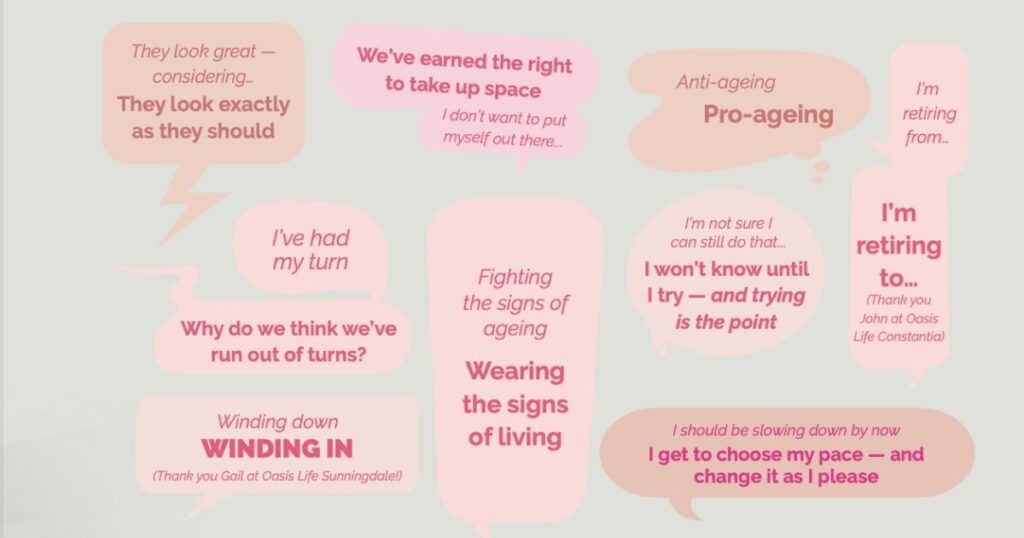
The Upside Is Just as Powerful
In just the same way that negative self-talk has negative effects, positive self-talk has measurable, beneficial consequences: supporting emotional regulation, lowering baseline stress and strengthening resilience. Some research goes further. Studies of adults in mid and later life have found that qualities like optimism and active coping are associated with longer telomeres, the protective caps at the ends of chromosomes that serve as a marker of cellular ageing. The evidence here is still emerging, but the direction of it is consistent: the inner voice is not just commentary. It participates.
“What we perceive and how we perceive it are guided by our priors, meaning our beliefs about how the world works,” says Wolf Singer, neuroscientist and director emeritus at the Max Planck Institute for Brain Research. When those priors are calm, empowering and optimistic, the nervous system tends to follow suit, helping us treat stressors as challenges rather than disasters.
How to Rewire Your Inner Voice: A Six-Step Practice
Dr Kristin Neff’s self-compassion work offers a practical framework for shifting internal dialogue from punitive to balanced. It is not about ignoring difficulty or thinking happy thoughts. It is about responding to difficulty with clarity and a self-perception of worthiness.
- Choose a process that suits you. Journalling, quiet reflection or speaking aloud to yourself or a trusted person. Pick what feels most natural.
- Notice how you speak to yourself. Especially when you feel vulnerable or have made a mistake. Is the tone cold, harsh, disappointed? Would you speak to a friend that way? Note it without judging it.
- Be compassionate to the critic. Respond kindly to your inner critic instead of trying to shut it down: “I know you’re trying to help, but this is hurting. What’s the deeper message here?” It feels awkward at first. It also works.
- Reframe with kindness. What would a wise, compassionate friend say, and in what tone? Replace blame with observations that are practical and grounded: “You aren’t a failure because you missed that meeting. You’ve been exhausted. Let’s get to bed earlier tonight.”
- Bring in a physical gesture. A hand on the heart anchors new self-talk somatically. Soothing touch is associated with the release of oxytocin, a hormone that promotes trust and connection.
- Repeat. Run the practice at least weekly over several weeks. By making your inner voice more of a coach and less of a critic, you lighten your mental load and support your health span.
When to Seek Help
If negative self-talk feels chronic, uncontrollable or overwhelming, speak to a professional. Persistent patterns can signal underlying anxiety or depression, and trauma often creates self-protective scripts that sound like “I should stay small” or “it is safer not to try”. These respond well to trauma-informed therapy, and getting that support is a strength, not a failure.


