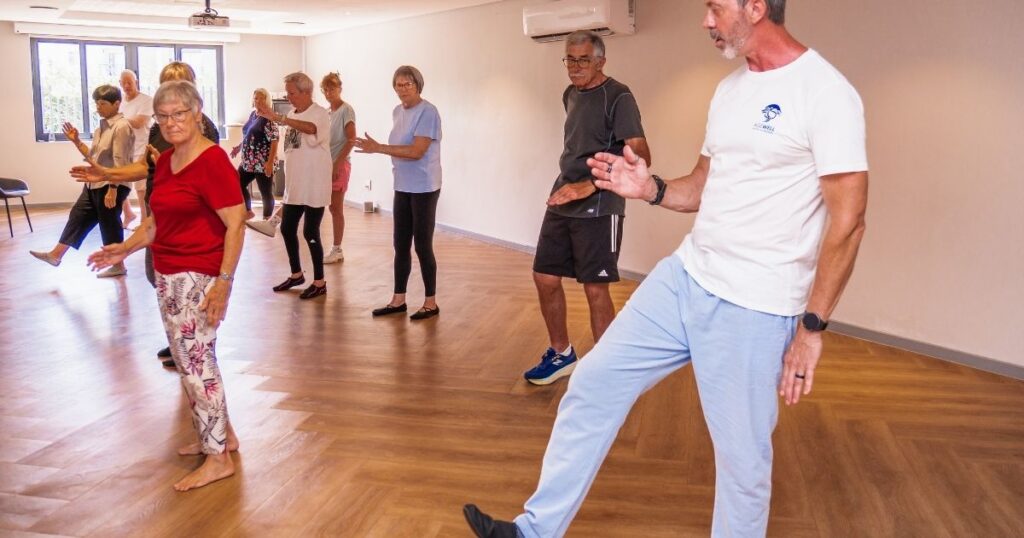
It doesn’t look like exercise. That, it turns out, is the whole point. Arms rise and fall. Weight shifts. Breath follows movement. To the uninitiated, tai chi can look rather odd. To the researchers who have spent decades studying it, it is one of the most effective longevity practices available to older adults anywhere in the world.
Where Tai Chi Comes From
Tai chi originated in China, commonly traced to the seventeenth century, where it developed as a martial art rooted in the Taoist principle of wu wei, which translates roughly as effortless action: yielding rather than forcing. For centuries it was practised as philosophy as much as movement, built on the idea that genuine strength does not announce itself and that the most powerful response to resistance is often to move with it. Modern research has since confirmed that the magic of tai chi is as much physiological as philosophical.
The Strength You Cannot See
What tai chi builds cannot be measured in a mirror. It works quietly, training the body’s ability to sense its own position in space and make the micro-adjustments that keep us upright, responsive and safe. This capacity, known as proprioception, is one of the first casualties of ageing and one of the primary contributors to falls. Conventional exercise does relatively little to address it. Tai chi addresses almost nothing else.
It also builds neuromuscular coordination: the ongoing conversation between brain and body that governs every movement we make. As we age, that conversation slows and the signals become less precise. Tai chi, with its deliberate weight-shifting sequences and continuous demand for balance and spatial awareness, keeps the conversation going.
What the Research Shows
The headline finding: a 2017 meta-analysis published in the Journal of the American Geriatrics Society found that tai chi practice may reduce the rate of falls in at-risk and older adults by approximately 43% in the short term, and injury-related falls by around 50%. Subsequent reviews consistently confirm tai chi as an effective fall-prevention intervention, with effectiveness increasing with practice frequency and duration.
Beyond falls, regular practice is associated with reduced cortisol, lower blood pressure, improved heart rate variability and better sleep quality, making it a genuinely useful tool for managing the chronic low-level stress that accelerates ageing at a cellular level. Harvard Medical School has described tai chi as “meditation in motion”: perhaps the single most accessible longevity practice available, requiring no equipment, no particular fitness level and no prior experience.
Who Tai Chi Suits
Almost everyone, which is rare in exercise science. Because movements are slow, low-impact and adaptable, tai chi suits people managing arthritis, joint replacements, balance concerns or simply a long break from structured exercise. It demands no performance and no physical intensity. It asks only that you slow down, deliberately, and pay full attention.
In a longevity conversation dominated by what to add, tai chi makes a quietly radical case: sometimes the most powerful intervention is subtraction. Less speed. Less force. More attention.
Trying It
If you’re curious, look for a beginner class with a patient instructor and give it four to six weeks before judging; the early sessions feel strange to almost everyone, and then something clicks. Residents at Oasis Life Burgundy Estate practice weekly in the Clubhouse Studio and tai chi is available across Oasis Life estates.